
[EFF19S6] Session 6: Gunter Peter Straschek – Early Films
Description
“A last chance to sow my wild oats” – Günter Peter Straschek at the German Film and Television Academy Berlin (DFFB)
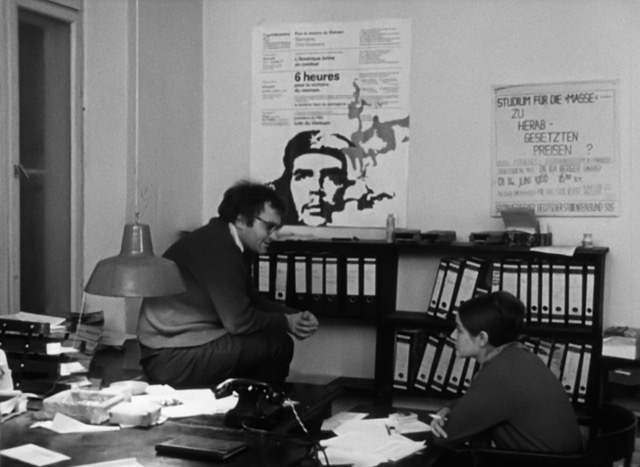
Günter Peter Straschek’s first short films are inseparable from the early history of the Deutsche Film- und Fernsehakademie Berlin (DFFB) and its politicisation. Together with 33 other students, including Harun Farocki, Hartmut Bitomsky, Holger Meins, Gerry Schum and Helke Sander, Straschek (1942-2009) belonged to the first generation of students at the newly founded academy. His stay at DFFB was short, as the dispute over his film A Western for the SDS (Ein Western für den SDS) resulted in his definitive expulsion in February 1968 and the mysterious disappearance of the film print. “At any rate,” Straschek said in retrospect, “the whole rigmarole was for me less a ‘coming to consciousness’ than the belated climax of a carefree youth that was now drawing to a close, a last chance to sow my wild oats.” The accompanying talks will shed some light on Straschek’s short films and their film school context, featuring documents from the DFFB archive.
Films: Hooray for Mrs. E. [Hurra für Frau E.], Günter Peter Straschek, West Germany, 1966, digital, 7 minutes, German with English subtitles
Straschek’s first film, Hooray for Mrs. E., is a sober portrait of a mother who supplements her welfare income with prostitution.
The Bridegroom, the Actress and the Pimp [Der Bräutigam, die Komödiantin und der Zuhälter], Jean-Marie Straub and Danièle Huillet, West Germany, 1968, digital, 23 minutes, German with English subtitles
Huillet and Straub’s short film, The Bridegroom, the Actress and the Pimp, shares concerns with Hooray for Mrs. E., in that it is also a film that reflects on the position of women in post-war Germany. The film is constructed in three sequences: a tracking shot through the streets of Munich at night, a staging of a play by Ferdinand Bruckner, and a related love story shot as a film noir.
A Western for the SDS [Ein Western für den SDS], Günter Peter Straschek, West Germany, 1967–1968, digital, 23 minutes, German with English subtitles
A Western for the SDS, which led to Straschek being expelled from the German Film and Television Academy, portrays the development of the Left as a learning process among women who sharpen their awareness in the movement but continue to have no say.
On the Concept of “Critical Communism” in Antonio Labriola (1843–1904) [Zum Begriff des “Kritischen Kommunismus” bei Antonio Labriola (1843–1904)], Günter Peter Straschek, West Germany, 1970, digital, 18 minutes, German with English subtitles
Straschek’s On the Concept of “Critical Communism” in Antonio Labriola addresses the chasm between workers and intellectuals and describes the “difficulties of the revolution” (Labriola) with a sharp sense of humour.
Introduction to Arnold Schoenberg’s “Accompaniment to a Cinematographic Scene” [Einleitung zu Arnold Schoenbergs Begleitmusik zu einer Lichtspielscene], Jean-Marie Straub and Danièle Huillet, West Germany, 1972, digital, 15 minutes, German with English subtitles
Introduction to Arnold Schoenberg’s “Accompaniment to a Cinematographic Scene” is Straub and Huillet’s fierce condemnation of the horrors of war and capitalism connecting the rise of fascism to imperialism, the role of Germany and the war in Vietnam, through the words of Schoenberg written in 1923 and Bertolt Brecht’s 1935 speech to the International Congress in Defence of Culture.
This session was accompanied by discussions with Volker Pantenburg (Freie Universität Berlin) and Julia Friedrich (Museum Ludwig, Cologne).
Presented as part of “The Films of Jean-Marie Straub and Danièle Huillet” in collaboration with Goethe-Institut London.
Previews
1 - EFF19S6 Introduction (EFF19S6 Gunter Peter Straschek early films Volker Pantenburg.WMA)
2 - EFF19S6 discussion (EFF19S6 Gunter Peter Straschek early films Volker Pantenburg and Julia Friedrich.WMA)
Collection Method
Data Objects
Offline / Analogue Data Records
There are no offline / analogue datasets associated with this recordExternal Data Records
There are no external datasets associated with this recordDigital Data Downloads
To download and items from this dataset, you must agree to abide by the licence attached to the individual items. If you make use of any item you download, you must also cite it in any publication or outputs of your own.
If you have any questions or would like additional information, please contact us at researchdata@bbk.ac.uk.


Metadata
| Dataset Title: | [EFF19S6] Session 6: Gunter Peter Straschek – Early Films |
||||||||||||||||
|---|---|---|---|---|---|---|---|---|---|---|---|---|---|---|---|---|---|
| Creators: | Temple, Michael and Barrington, Matthew |
||||||||||||||||
| Dataset Contributors: |
|
||||||||||||||||
| Subjects: | |||||||||||||||||
| Data collection method: | The Essay Film Festival, active since 2015, presents a global range of contemporary and restored essayistic works. The events are now archived here for research purposes. |
||||||||||||||||
| Collection period: |
|
||||||||||||||||
| Statement on legal, ethical, and access issues: | All film stills were provided by participating artists. |
||||||||||||||||
| Depositing User: | Emma Yapp | ||||||||||||||||
| Date Deposited: | 07 Jul 2026 14:12 | ||||||||||||||||
| Last Modified: | 07 Jul 2026 14:12 | ||||||||||||||||
| Publisher: | Birkbeck College, University of London |
 https://orcid.org/0000-0002-2916-9876
Export / Share Citation
Impact & Reach

Additional statistics for this dataset are available via IRStats2.