
[EFF17S16] Session 16: Screenings and discussion with filmmaker Jocelyne Saab
Description
Filmmaker Jocelyne Saab discusses her “Beirut trilogy” in conversation with Tim Markham, Birkbeck, and Stefanie Van de Peer, University of Exeter.
Films: Beirut Nevermore [Beyrouth, jamais plus], Jocelyne Saab, Lebanon, 1976, digital, 36 minutes, English-language version
The film is an elegy for the city of Beirut and was shot during a period when the war hostilities had ceased momentarily, and people were attempting to reconstruct their lives amongst the rubble and destruction of war. Shot over six months, the first half of the film shows us images of a destroyed city, of empty streets, bombarded buildings, random objects, of children playing, accompanied by a voiceover written by poet and artist Etel Adnan, telling us how they “the unusual has destroyed the order of things”. People relate their experiences of desolation and the suffering from the battles. This city portrait is Saab’s first attempt to articulate in personal terms her experience of the war and to rework in essayistic form her previous filmic and journalistic coverage of the history of her country and its conflicts. The essay film is infused with the uncertainty and violence caused by the destruction of a place she had known and that she felt was lost forever.
Letter from Beirut [Lettre de Beyrouth], Jocelyne Saab, Lebanon, 1978, digital, 48 minutes, English-language version
This highly personal and original film is an attempt by the filmmaker to come to terms with her experience of war and current events in Lebanon. Saab is like a character in her own story, returning to a country and a city that she no longer recognises. The film works through subtle transitions between fiction and documentary, and a series of letters with a text written by Etel Adnan, whose novel Sitt Marie Rose, published one year earlier in 1977, Saab considered to be the best novel about the Lebanese conflict. While traveling around Beirut and to South Lebanon, the filmmaker muses about the country, its politics, censorship, listening to people who speak openly about their lives and what they hope for the future. The film was described as a panorama of Lebanese society and its problems, revisiting the history of Lebanon and the wages of occupation, while showing people’s everyday life during a time of conflict.
Beirut, My City [Beyrouth, ma ville], Jocelyne Saab, Lebanon 1982, digital, 33 minutes, French with English subtitles
Shot seven years into the war in July 1982 while Beirut was under siege by the Israeli army, the film is another heartfelt tribute to an almost deserted city reduced to rubble after years of conflict. Saab, acting like a reporter of her own history, tells us about the destruction of her house, a 150-year-old building. The film is haunted by the history and memory of places and names and by the stark reality and unbearable violence of the war. The voice over of the film was written by Roger Assaf, a playwright, director and actor, whose work has been profoundly marked by the collective experience of war.
With special thanks to Jocelyne Saab, Miriam Heard, and Nicole Brenez.
Following this event there was a book launch for Negotiating Dissidence: The Pioneering Women of Arab Documentary by Stefanie Van de Peer: https://edinburghuniversitypress.com/book-negotiating-dissidence.htmlhttps://edinburghuniversitypress.com/book-negotiating-dissidence.html
Previews
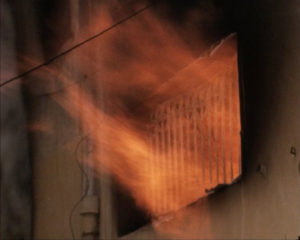
1 - EFF17S16 Discussion (EFF17S16 Jocelyne Saab discussion 1.4.17.WMA)
Collection Method
Data Objects
Offline / Analogue Data Records
There are no offline / analogue datasets associated with this recordExternal Data Records
There are no external datasets associated with this recordDigital Data Downloads
To download and items from this dataset, you must agree to abide by the licence attached to the individual items. If you make use of any item you download, you must also cite it in any publication or outputs of your own.
If you have any questions or would like additional information, please contact us at researchdata@bbk.ac.uk.


Metadata
| Dataset Title: | [EFF17S16] Session 16: Screenings and discussion with filmmaker Jocelyne Saab |
||||||||||||
|---|---|---|---|---|---|---|---|---|---|---|---|---|---|
| Creators: | Temple, Michael and Barrington, Matthew |
||||||||||||
| Dataset Contributors: |
|
||||||||||||
| Subjects: | |||||||||||||
| Data collection method: | The Essay Film Festival ran between 2015 and 2023, and presented a global range of contemporary and restored essayistic works. The events are now archived here for research purposes. |
||||||||||||
| Collection period: |
|
||||||||||||
| Statement on legal, ethical, and access issues: | All film stills were provided by participating artists. |
||||||||||||
| Depositing User: | Emma Yapp | ||||||||||||
| Date Deposited: | 19 Aug 2026 09:58 | ||||||||||||
| Last Modified: | 19 Aug 2026 09:58 | ||||||||||||
| Publisher: | Birkbeck College, University of London |
 https://orcid.org/0000-0002-2916-9876
Impact & Reach

Additional statistics for this dataset are available via IRStats2.