
[EFF17S2] Session 2: Thinking Cinema on Television, part one: Westdeutscher Rundfunk (WDR), ca. 1975
Description
Soundcloud Link: https://soundcloud.com/user-952189740/thinking-cinema
Contemporary discussions tend to advocate the idea that the “video essay” was born from the felicitous encounter of platforms like YouTube, social media, cinephilia 2.0, inexpensive DIY editing software, and the accessibility of films as data. If a historical (proto-digital) perspective is taken into account, it either conjures up established essayistic masters like Jean-Luc Godard or Chris Marker, or it tries to ennoble the genre as the legitimate successor of the found footage tradition in experimental cinema.
However, there are other, less glamorous sites where an investigation of cinema by its own means was pursued with enthusiasm and inventiveness. One important centre of activity was the film department of the Westdeutscher Rundfunk (WDR) in Cologne. Starting around 1970, commissioning editors like Wilfried Reichart, Werner Dütsch, Angelika Wittlich, Helmut Merker, and Georg Alexander produced and commissioned a variety of different productions that devised ways of combining images and sounds to address the aesthetics and history of cinema. Using their production budget to run the film department like a cinémathèque, they organised retrospectives and accompanied them with analytic and contextual programs directed, among others, by Hartmut Bitomsky, Harun Farocki, Helmut Färber, Frieda Grafe, Martina Müller, Enno Patalas.
“Thinking Cinema on Television”, curated and presented by Volker Pantenburg, shows a small selection of three productions from 1975, broadcast in October, November and December of this year, combined with a programme by commissioning editor Werner Dütsch and two short films by Peter Nestler. Looking at the WDR productions allows a glimpse at a network of individuals, alliances (like the close link between WDR and the journal FILMKRITIK) and intellectual labour.
In collaboration with the Goethe-Institut London, and with thanks to Deutsche Kinemathek – Museum für Film und Fernsehen, Filmmuseum München, Harun Farocki GbR, and Westdeutscher Rundfunk (WDR)
Introduced by Volker Pantenburg and featuring Werner Dütsch in conversation.
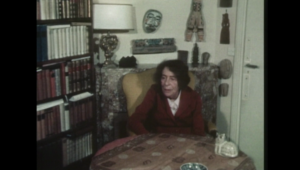
Films: Filmemigration aus Nazi-Deutschland – Teil 1 (Film Emigration from Nazi Germany – Part 1), Günter Peter Straschek, Germany, 1975, digital, 60 minutes, German with English subtitles
Günter Peter Straschek (1942–2009) belonged to first group of students of the Deutsche Film- und Fernsehakademie Berlin (dffb). He started studying film in 1966 together with Hartmut Bitomsky, Harun Farocki, Holger Meins, Helke Sander, and others. His student film Ein Western für den SDS was confiscated by the director of the school, and the ensuing occupation of the director’s office led to the relegation of Straschek and other students in 1968. This is the first episode of a five-part series consisting of comprehensive interviews with people who had worked in the German film industry before they were forced into exile during the Nazi period. Apart from some radio features and articles, this 290-minute TV programme remains the only published trace of Günter Peter Straschek’s lifelong work on the emigration of film personnel. He intended to publish a three-volume book, encompassing all available data about 3,000 emigrants originating from the centre and peripheries of film production. However, this book never materialised.
Fritz Lang, Werner Dütsch, Germany 1974/1990, digital, 45 minutes, German with English subtitles
Werner Dütsch was one of the most prolific commissioning editors at the WDR film department, producing work by Helmut Färber, Harun Farocki, Hartmut Bitomsky, and many others. His Fritz Lang is a reworked version of an earlier program on the German director (Die schweren Träume des Fritz Lang, 1974). Like other commissioning editors at the WDR, Dütsch not only organised TV-retrospectives, and initiated and co-produced work by others, but he also worked as an author and director. Fritz Lang is organised as a dialogue between two voices (Dütsch and Martina Müller), addressing the main themes and obsessions of the director. The film is full of concise observations: “There is a lot of killing in Lang’s films; with energy, skill, and arrogance. Images of bodies, falling heavy and helplessly, follow. As if the dead, with their specific weight, wanted block the way of the living.”
Previews
1 - EFF17S2 Part 1 (EFF17S2 Thinking Cinema on Television Part 1.MP3)
2 - EFF17S2 Part 2 (EFF17S2 Thinking Cinema on Television Part 2.MP3)
Collection Method
Data Objects
Offline / Analogue Data Records
There are no offline / analogue datasets associated with this recordExternal Data Records
There are no external datasets associated with this recordDigital Data Downloads
To download and items from this dataset, you must agree to abide by the licence attached to the individual items. If you make use of any item you download, you must also cite it in any publication or outputs of your own.
If you have any questions or would like additional information, please contact us at researchdata@bbk.ac.uk.


Metadata
| Dataset Title: | [EFF17S2] Session 2: Thinking Cinema on Television, part one: Westdeutscher Rundfunk (WDR), ca. 1975 |
||||||||||||
|---|---|---|---|---|---|---|---|---|---|---|---|---|---|
| Creators: | Temple, Michael and Barrington, Matthew |
||||||||||||
| Dataset Contributors: |
|
||||||||||||
| Subjects: | |||||||||||||
| Data collection method: | The Essay Film Festival ran between 2015 and 2023, and presented a global range of contemporary and restored essayistic works. The events are now archived here for research purposes. |
||||||||||||
| Collection period: |
|
||||||||||||
| Statement on legal, ethical, and access issues: | All film stills were provided by participating artists. |
||||||||||||
| Depositing User: | Emma Yapp | ||||||||||||
| Date Deposited: | 30 Jun 2026 12:04 | ||||||||||||
| Last Modified: | 18 Aug 2026 10:00 | ||||||||||||
| Publisher: | Birkbeck College, University of London |
 https://orcid.org/0000-0002-2916-9876
Export / Share Citation
Impact & Reach

Additional statistics for this dataset are available via IRStats2.